Japan Kompass › Planning & costs
Preparing for Japan: The Pre-Trip Checklist
Entry, money, phone, trains, power plugs, food and emergencies: what to sort out before your first trip to Japan – compact and dated.
Does any of this apply to you?
Pick one or more and we will show extra notes in the article.
US dollar amounts are rounded estimates at US$1 = ¥159 (as of 26 November 2026). The actual rate varies.
Planning your first trip to Japan? This checklist sums up what to take care of before you fly. Rules and prices in Japan change regularly, so double-check anything with a deadline with the official sources shortly before you go.
1. Entry: passport and visa
- Visa: citizens of many countries do not need a visa for tourist stays of up to 90 days. Check with Japan’s Ministry of Foreign Affairs whether this applies to you.
- Passport: it must be valid for your whole stay.
- Visit Japan Web: this official online service lets you fill in immigration and customs details before your flight and gives you a QR code. It saves time at the airport.
- Coming up: Japan plans an electronic travel authorisation called “JESTA”, similar to the US ESTA. It is scheduled for 2028 – nothing to do until then.
2. Money: cash and cards
- Credit cards are widely accepted in cities, hotels and chains. In small restaurants, temples and the countryside you will often still need cash.
- ATMs in 7-Eleven stores and many post offices accept foreign cards for yen withdrawals.
- Bring some cash for the first days and check your bank’s fees for withdrawals abroad.
3. Phone and internet
- The easiest option is an eSIM for Japan: buy it online before you leave, activate it after landing, done. Check first that your phone supports eSIM and is not locked to a carrier.
- Alternatives are pocket Wi-Fi routers for rent or physical SIM cards at the airport.
- Mobile data is almost essential in Japan: for maps, train connections and translation.
4. Trains and local transport
- IC card: with a rechargeable card such as Suica or PASMO you can pay for subways, buses and even convenience-store purchases. On an iPhone you can add Suica directly to Apple Wallet.
- Japan Rail Pass: the nationwide JR Pass has been much more expensive since the price rise in October 2023. It usually only pays off if you take several long Shinkansen journeys within a few days. For many routes regional passes or single tickets are cheaper – work out your route first.
- Luggage: large suitcases make Shinkansen travel awkward. Japanese luggage forwarding services (takkyubin) send your case from hotel to hotel cheaply, usually by the next day. You can then handle station stairs and transfers with light bags – especially useful if you are less mobile or travelling with children.
- Large luggage: on the Tokaido, Sanyo and Kyushu Shinkansen, bags with total dimensions (length + width + height) over 160 cm and up to 250 cm need a reserved “seat with oversized baggage area”. Bringing one without a reservation costs a ¥1,000 (≈ US$6) fee, and bags over 250 cm are not allowed.
5. Power and plugs
- Japan uses type A plugs (two flat pins) and 100 volts.
- Phone and laptop chargers generally handle the voltage (look for “100–240 V” on the charger). High-power devices such as hair dryers or straighteners may not work properly.
6. Where to stay and when to go
| Period | What to expect |
|---|---|
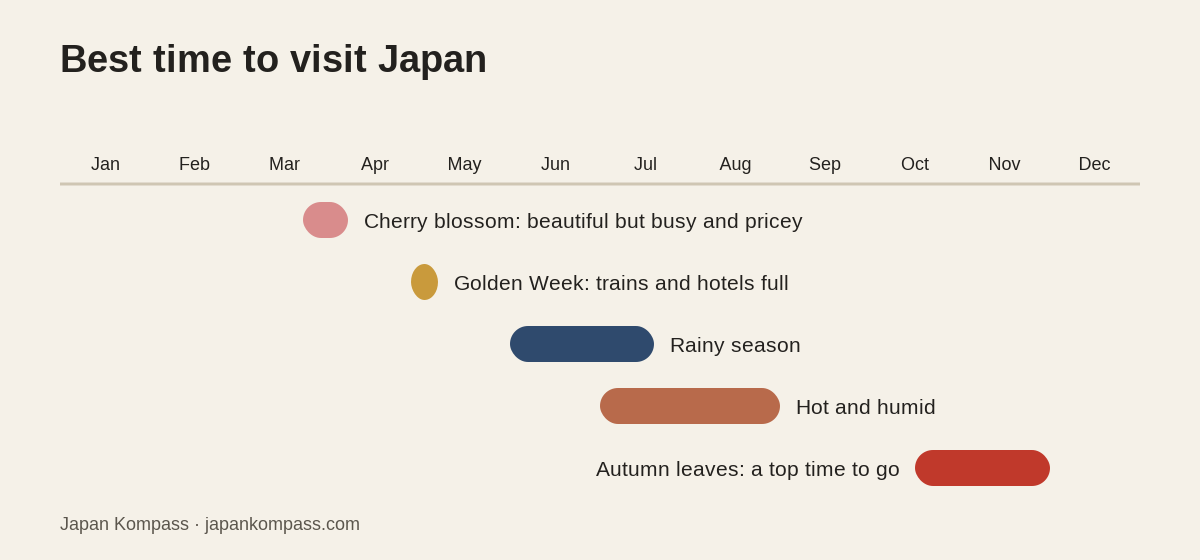
| Late March – early April | Cherry blossom: beautiful, but very busy and expensive. Book early. |
| Late April – early May | Golden Week: Japanese holidays, trains and hotels very full. |
| June – mid-July | Rainy season across much of the country. |
| July – August | Hot and humid. |
| October – November | Autumn leaves and pleasant temperatures – one of the best times to go. |
Hotel rooms in Japan are often small, and facilities vary a lot. Check what matters to you before booking – for example the bathroom, the beds or whether smoking is allowed.
7. Food and food allergies
- Packaged food in Japan must label 9 allergens: shrimp, crab, walnuts, wheat, buckwheat, egg, milk, peanuts and cashews (cashews since April 2026; until March 2028 some products may still lack this label). Restaurants, food stalls and food sold loose have no labelling obligation.
- Many Japanese dishes are based on dashi, a stock made from bonito flakes or dried sardines. Even dishes that look vegetable-only, such as miso soup, udon and soba broth or simmered dishes, often contain fish.
- If there is something you cannot eat, carry a card that states it specifically in Japanese and show it at restaurants.
8. Tax-free shopping
Tourists can shop tax-free in many stores – if they spend at least ¥5,000 (≈ US$31) (before tax) in the same store on the same day. For purchases from 1 November 2026, a refund system applies: you pay consumption tax at the till and get it back after customs confirms the export when you leave the country. Carry your passport when shopping and allow extra time at departure.
9. Medicine, insurance and emergencies
- Medicine: you can bring up to 1 month’s supply of prescription medicine without paperwork. For larger amounts you need an import certificate (“Yakkan Shomei”) before you travel. Medicines containing stimulants (such as some ADHD medication) are banned. Bring an English prescription or a letter from your doctor.
- Insurance: as a tourist, treatment in Japan is not covered by your public health insurance at home. Travel insurance with medical cover is a must.
- Emergency numbers: police 110, ambulance and fire 119. JNTO’s “Japan Visitor Hotline” (050-3816-2787) helps 24 hours a day, all year round, in English, Chinese and Korean with illness or accidents.
Checklist
- Passport valid for the whole trip
- Visit Japan Web completed
- eSIM or pocket Wi-Fi sorted
- Some cash and a card with fair foreign fees
- IC card set up (e.g. Suica in Apple Wallet)
- Route calculated: JR Pass, regional pass or single tickets?
- Plug adapter (if needed)
- Accommodation booked (especially for cherry blossom and autumn)
- For allergies or dietary rules: a card in Japanese
- Medicine and an English prescription
- Travel insurance with medical cover
- Emergency numbers saved on your phone
Last checked: November 2026. No guarantee – please check entry and tax rules with the official sources before you travel.