Japan Kompass › Planning & costs
How Much Does a Trip to Japan Cost? A 2-Week Budget
Accommodation, food, transport, sights and hidden costs: realistic prices for 2 weeks in Tokyo, Kyoto and Osaka – budget, standard or comfort.
Does any of this apply to you?
Pick one or more and we will show extra notes in the article.
US dollar amounts are rounded estimates at US$1 = ¥159 (as of 26 November 2026). The actual rate varies.
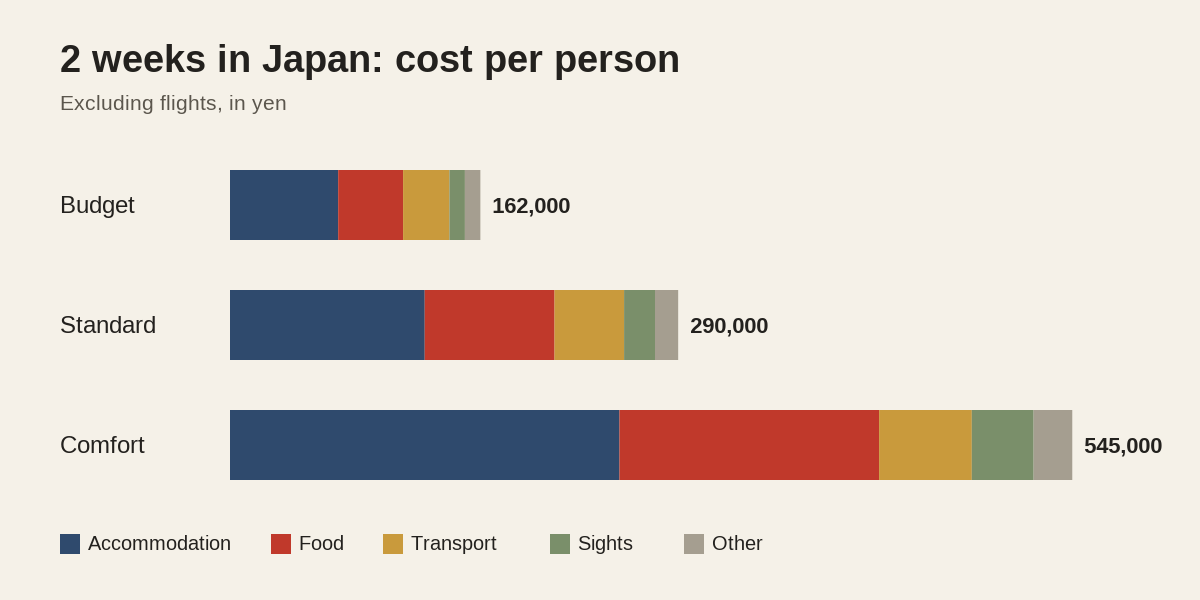
How much does a trip to Japan cost? Using a 2-week trip (14 nights) through Tokyo, Kyoto and Osaka as an example, we show the cost per person at three levels: budget, standard and comfort. Flights are not included because they depend so much on where you fly from. All amounts are in yen, each followed by a rough equivalent in US dollars.
1. Cost of 2 weeks at a glance
| Item | Budget | Standard | Comfort |
|---|---|---|---|
| Accommodation (14 nights) | ¥70,000 (≈ US$440) | ¥126,000 (≈ US$790) | ¥252,000 (≈ US$1,600) |
| Food | ¥42,000 (≈ US$260) | ¥84,000 (≈ US$530) | ¥168,000 (≈ US$1,100) |
| Transport | ¥30,000 (≈ US$190) | ¥45,000 (≈ US$280) | ¥60,000 (≈ US$380) |
| Sights & entry fees | ¥10,000 (≈ US$63) | ¥20,000 (≈ US$130) | ¥40,000 (≈ US$250) |
| Other (eSIM, luggage forwarding, etc.) | ¥10,000 (≈ US$63) | ¥15,000 (≈ US$94) | ¥25,000 (≈ US$160) |
| Total (excluding flights) | ¥162,000 (≈ US$1,000) | ¥290,000 (≈ US$1,800) | ¥545,000 (≈ US$3,400) |
Accommodation is the per-person share when 2 people share a room. Solo travellers pay for the room alone, so accommodation costs more than shown. All figures are estimates based on the prices explained below. Hotel prices rise sharply during cherry blossom and autumn foliage season.
2. Accommodation
- Business hotels: a room for 2 people costs on average about ¥17,500 (≈ US$110) per night in Tokyo and about ¥19,700 (≈ US$120) in Kyoto (estimate for October 2026). Tokyo prices are up about 14% on the previous year. With 2 people, that is about ¥9,000–10,000 (≈ US$57–63) per person.
- Capsule hotels and dorms: some start from around ¥2,000 (≈ US$13) per person per night, but most cost more and prices vary by season and day of the week. A strong option for solo travellers on a budget.
- City hotels and ryokan: for more comfort, budget at least ¥15,000 (≈ US$94) per person per night.
- Accommodation tax: some cities charge an accommodation tax on top of the room rate. In Kyoto, the following rates apply from March 2026, based on the price per person per night. You pay it at your accommodation.
| Price per person per night | Kyoto accommodation tax |
|---|---|
| under ¥6,000 (≈ US$38) | ¥200 (≈ US$1) |
| ¥6,000 to under ¥20,000 (≈ US$38–130) | ¥400 (≈ US$3) |
| ¥20,000 to under ¥50,000 (≈ US$130–310) | ¥1,000 (≈ US$6) |
| ¥50,000 to under ¥100,000 (≈ US$310–630) | ¥4,000 (≈ US$25) |
| ¥100,000 (≈ US$630) and above | ¥10,000 (≈ US$63) |
3. Transport
- Shinkansen: Tokyo to Kyoto costs ¥14,170 (≈ US$89) in a reserved seat on the “Nozomi” (regular season). On the “Hikari” or “Kodama” it is ¥13,850 (≈ US$87); peak periods cost more and off-peak periods less. The roomier Green Car costs ¥19,040 (≈ US$120) on the “Nozomi”. Reserved seats on the “Nozomi” are set to go up by ¥700 (≈ US$4) from July 2027.
- Japan Rail Pass: the nationwide 7-day pass (ordinary class) went up from ¥50,000 to ¥53,000 (≈ US$330) in October 2026 when bought through overseas sales agents. On the official website it is still sold for ¥50,000 (≈ US$310) for the time being. If you only travel between Tokyo, Kyoto and Osaka by Shinkansen and back, single tickets are cheaper.
- Local transport: an IC card is the easiest way to pay for subways and buses. In Tokyo, the “Tokyo Subway Ticket” for visitors gives unlimited rides on all Tokyo Metro and Toei lines (from March 2026: 24 hours ¥1,000 ≈ US$6, 48 hours ¥1,500 ≈ US$9, 72 hours ¥2,000 ≈ US$13). Kyoto has a “Subway & Bus 1-Day Pass” (adults ¥1,100 ≈ US$7).
- Kyoto city buses: Kyoto aims to introduce higher fares for non-residents during fiscal year 2027 (under the mayor’s proposal, ¥360 ≈ US$2 for adults who don’t live in Kyoto). This is not final yet, so check before your trip.
- Taxi: useful if you want to walk less. In Tokyo’s 23 wards, the starting fare is up to ¥500 (≈ US$3) for the first 1.096 km, then rises with distance and time.
4. Food
- At ramen and gyoza restaurants, customers spent an average of ¥1,005 (≈ US$6) per person in 2025. A bowl of ramen at popular chains in Tokyo costs around ¥1,000 (≈ US$6).
- With onigiri or bread from a convenience store, breakfast costs just a few hundred yen.
- Tipping is not expected in Japanese restaurants.
- If you eat vegetarian, halal or avoid allergens, suitable places are fewer and sometimes pricier, so budget more for food.
5. Sights & entry fees
- Shrines, many parks and wandering the streets cost nothing.
- Paid examples: Shinjuku Gyoen ¥500 (≈ US$3) and Kinkaku-ji ¥500 (≈ US$3) (adults). Since March 2026, Himeji Castle costs ¥2,500 (≈ US$16) for adults who don’t live in Himeji (free under 18).
- Some places have child or senior prices, but the conditions differ. Bring your passport as proof of age and ask at the ticket counter.
6. Costs that are easy to overlook
- Medical costs: as a tourist you are not covered by Japan’s public health insurance. Treatment is billed privately at prices set by the clinic, and serious illness has led to bills of nearly ¥10,000,000 (≈ US$63,000). Make sure you have travel insurance that covers medical treatment.
- Departure tax (International Tourist Tax): leaving Japan costs ¥3,000 (≈ US$19) per person (since July 2026, up from ¥1,000 ≈ US$6). It is usually included in your air fare.
- Tax-free shopping: since November 2026, you pay the full price including tax and get the tax back after customs confirms the export when you leave. It applies to purchases of at least ¥5,000 (≈ US$31) (before tax) in the same store on the same day.
- Bringing food: meat and meat products – even processed ones such as jerky or sausage – generally cannot be brought into Japan. If you planned to bring familiar food, budget to buy it locally.
- Accommodation tax: see section 2.
- Luggage forwarding: takkyubin takes items up to 200 cm in total dimensions and 30 kg, so most large suitcases can be sent.
- Luggage forwarding (takkyubin) and eSIM: they make the trip much easier, so include them in your budget.
7. Tips for saving money
- Avoid the peaks of cherry blossom season, Golden Week and autumn foliage.
- If Kyoto hotels are too expensive, stay in Osaka or nearby and commute.
- Make lunch your main meal.
- Before buying a JR Pass, check whether single tickets are cheaper.
Sources
- Hotel prices: https://hotelbank.jp/trends/tokyo-business-hotel-adr-benchmark-double-room-2026-10/
- Kyoto accommodation tax: https://ja.kyoto.travel/news/format.php?id=532
- Shinkansen fares: https://tabiris.com/?p=22528
- Shinkansen price rise: https://www.westjr.co.jp/press/article/2026/10/16/items/261016_00_press_shinkansen_ryoukin.pdf
- Japan Rail Pass: https://www.jreast.co.jp/press/2026/20260409_ho02.pdf
- Tokyo Subway Ticket: https://www.tokyometro.jp/lang_en/ticket/value/travel/
- Kyoto bus fares: https://www.businessinsider.jp/article/2609-kyoto-city-bus-dual-price-system-for-overtourism/
- Taxi fares: https://wwwtb.mlit.go.jp/kanto/content/000357954.pdf
- Spending at ramen restaurants: https://www.dreamnews.jp/press/0000343769
- Himeji Castle: https://www.himejicastle.jp/en
- Shinjuku Gyoen: https://www.env.go.jp/garden/content/000110893.pdf
- Medical costs for visitors: https://www.mlit.go.jp/kankocho/content/001992896.pdf
- Departure tax: https://www.mlit.go.jp/kankocho/seisaku_seido/kihonkeikaku/inbound_kaifuku/ryokakuzei.html
- Meat product import rules: https://www.maff.go.jp/aqs/english/product/import.html
- Spending by nationality: https://www.mlit.go.jp/kankocho/content/002020010.pdf
Last checked: November 2026. Prices change – check the latest prices on the official websites before booking.